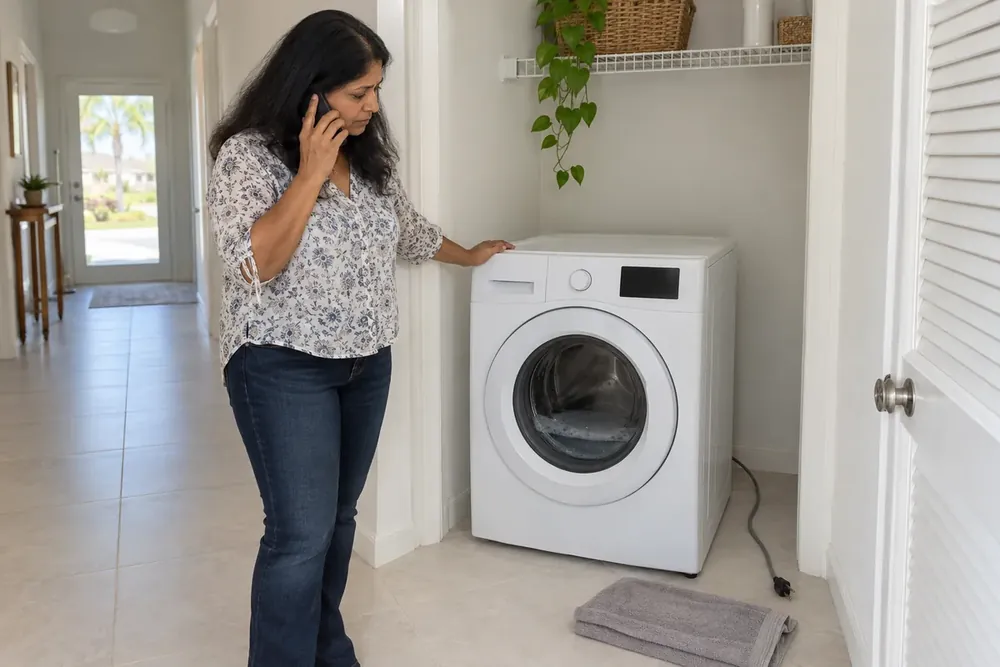
Your Call Starts the Repair Process
Call to describe the appliance problem, and the next steps move from understanding the symptoms to testing the repair. You do not need to know which part has failed. A washer holding water might have a restricted drain, for example, but the symptom alone does not identify the cause.
Describe the Appliance and the Change
Start with the appliance, what it is doing, and your town. Your call connects you with one of our local appliance repair partners. Say whether the trouble began suddenly or became more noticeable over several cycles. A new noise, standing water, or a cycle that stops early gives the conversation a useful starting point.
If the brand and model label are easy to find, those details help identify the appliance. There is no need to move anything or find paperwork to make the call. If a display shows an error code, read it out during the conversation. Codes depend on the brand and model, so the same letters or numbers do not always mean the same fault.
Your Technician Traces the Cause
Your technician checks the appliance to find why its normal operation has changed. A drain pump is the part that moves used water out of a washer. When debris restricts the water path, water can remain in the drum even though the pump still runs. Testing separates a blockage from a failed part.
Describe what happened during the last cycle rather than trying to reproduce the fault. The inspection focuses on the symptoms you reported and the parts involved. Your technician explains the findings in ordinary words, including how the suspected failure produced the trouble.
Understand the Work and the Price
Your technician explains the proposed repair and its price before repair work begins. The appliance's design, access to the affected part, and the amount of work required shape the cost. A removable part near the front may involve different work from a component buried inside the appliance.
You decide whether to proceed after the explanation. Ask what the repair addresses and whether another fault also needs attention. Identifying the cause matters because replacing a damaged part without addressing the reason it failed can leave the original problem unresolved.
Repairs Include Testing and Any Needed Return
Your technician carries out the agreed repair and checks the affected operation afterward. A washer drainage repair, for instance, needs a check that water leaves the drum as intended. The test follows the particular fault rather than relying only on whether the appliance turns on.
A part that needs ordering means a return visit to complete the repair. Your technician explains the remaining work and arranges that next step.
Keep the Appliance Safe While Waiting
Switch the appliance off at its controls, or unplug it only when the plug is easy and dry to reach. Avoid running repeated cycles to see whether a fault disappears. Keep a warm refrigerator closed as much as possible to reduce further loss of cold air.
If you smell gas, leave the home and call 911 or the gas company from outside. Describe the appliance trouble during your repair call without opening covers or taking anything apart.